In the rapidly evolving landscape of 2026, where AI assistants have become as common as smartphones, Claude by Anthropic has carved out a unique reputation. While other models focus on aggressive automation, Claude has doubled down on Nuance, Ethics, and “Editorial Quality” reasoning. With the recent release of Claude Opus 4.6 and the revolutionary “Cowork” autonomous agent, Claude is no longer just a chatbot—it is a sophisticated thinking partner.
At Milioudis Technology And Software News, we have spent weeks testing the latest 2026 updates. If you are a writer, a developer, or a researcher who values precision over “AI-isms,” this is the tool you’ve been waiting for.
1. What is Claude AI in 2026?
Claude is an advanced AI assistant developed by Anthropic, a company founded by former OpenAI executives with a heavy focus on Constitutional AI (AI built with a literal “constitution” of safety and ethical rules).
In 2026, Claude is defined by its Long-Context Memory (up to 1 million tokens in beta) and its ability to handle complex, multi-layered instructions without losing track. It is available via the web, a dedicated desktop app (now on both Windows and Mac), and mobile devices.
2. What’s New in the March 2026 Update?
The March 2026 update (specifically the Sonnet 4.5 and Opus 4.6 models) introduces features that bridge the gap between “chatting” and “doing.”
A. Claude Cowork (Autonomous Agents)
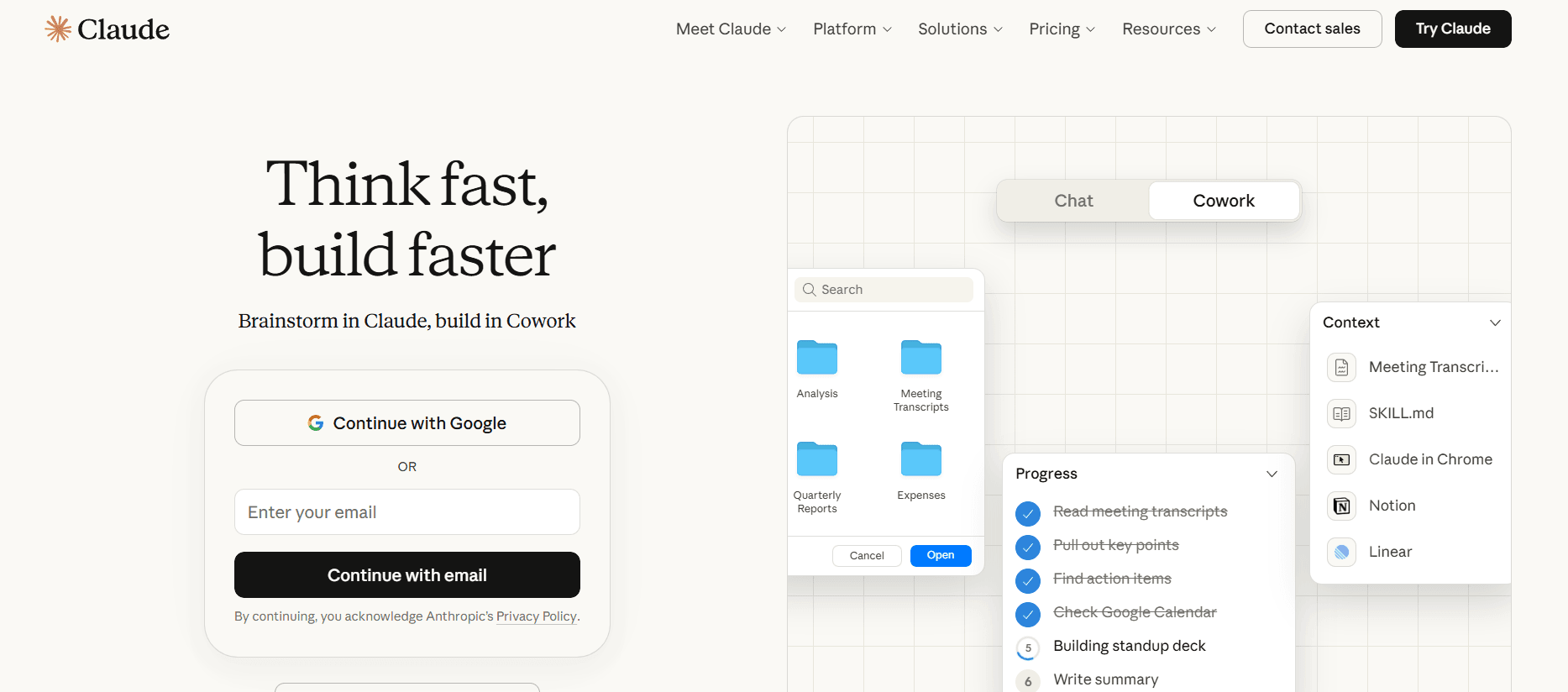
The standout feature of 2026 is Cowork. Unlike standard chat, Cowork allows Claude to operate as an autonomous agent. You can grant it access to a specific folder on your computer, and it can:
- Read and analyze dozens of files simultaneously.
- Execute code in a safe, isolated “sandbox” environment.
- Perform multi-step tasks like “Read these 10 PDFs, summarize them into a PowerPoint, and draft a follow-up email.”
B. Claude Code (Terminal Integration)
For the developers at milioudis.com, Claude Code is a game-changer. It is a command-line interface (CLI) tool that lives in your terminal. It understands your entire codebase, can run tests, debug failures, and even commit changes to GitHub. In 2026, Claude Code (powered by Opus 4.6) achieved a record-breaking 80.8% score on SWE-bench, making it the most capable coding AI on the market.
C. Artifacts 2.0 & Inline Visualizations
Claude’s Artifacts feature has been upgraded. Now, when Claude writes code or creates a website mockup, it renders a live, interactive preview on the side of your screen. In the 2026 version, you can now generate live charts, architectural diagrams (Excalidraw), and even React-based animations directly within the chat interface.
3. The Model Hierarchy: Opus, Sonnet, and Haiku
In 2026, Anthropic uses a three-tier model system to balance speed and intelligence:
- Claude Opus 4.6 (The Brain): The most intelligent model. It excels at complex reasoning, deep research, and high-level coding. It is the only model that can handle “Long-Horizon” tasks that take hours to complete.
- Claude Sonnet 4.5 (The Balanced): The default model for most users. It is 2x faster than Opus but still highly capable of professional writing and data analysis.
- Claude Haiku 4.5 (The Speedster): Designed for near-instant responses. It is perfect for simple translations, summarizing short texts, and powering customer service bots.
4. Why Claude is Better for Writers and Researchers
While competitors are often criticized for “robotic” writing, Claude has become the favorite of the creative community for three reasons:
- Natural Prose: Claude avoids clichés like “in today’s digital landscape” or “tapestry of possibilities.” It writes with an editorial, human-like tone.
- Large Context Window: You can upload an entire book (or three) and ask Claude to find a specific contradiction. In 2026, its memory is virtually unmatched.
- Instruction Adherence: If you tell Claude “do not use the letter ‘e’ in your response,” it will actually follow that rule perfectly.
5. Subscription Plans for 2026
Anthropic has expanded its pricing to compete with OpenAI:
- Free Tier: Access to Sonnet 4.5 with daily message limits.
- Claude Pro ($20/mo): 5x more usage, priority access to Opus 4.6, and the Cowork agent.
- Claude Max ($100/mo): A new high-tier plan for 2026, offering massive usage limits and early access to experimental features like Claude in PowerPoint/Excel.
- Claude Team ($20/user/mo): For businesses, including administrative controls and shared project spaces.
6. How and Where to Download (Official Sources)
Security is critical when using AI that has access to your files. Only download Claude from official Anthropic sources.
Official Download Links:
- Windows & macOS Desktop App: claude.ai/download (The Windows version was fully released in Feb 2026 with Cowork support).
- iOS (iPhone/iPad): Apple App Store
- Android: Google Play Store
Installation Note: The Desktop App is highly recommended over the web version because it allows for “System Shortcuts” and deeper integration with the Cowork agent.
7. Pro Tips for Milioudis Technology Readers
- Use Projects: In 2026, don’t just start a new chat. Create a “Project” in Claude. You can upload your “Style Guide” or “Code Base” to the project, and Claude will remember that context for every chat within that project.
- MCP (Model Context Protocol): Connect Claude to your Google Workspace or Slack using MCP connectors. This allows Claude to search your real-time data to answer questions.
- The Off-Peak Promotion: (March 2026 Tip) Anthropic is currently offering double usage limits during off-peak hours (12 PM – 6 PM GMT) for all paid users.
- Formatting Artifacts: If you need a diagram, ask Claude: “Generate an Excalidraw diagram for this architecture.” You can then edit that diagram directly in your browser.
8. Final Verdict
Claude 2026 is the thinking man’s AI. It doesn’t just give you a fast answer; it gives you a reasoned answer. With the addition of the Cowork agent and the power of Opus 4.6, it has moved from being a simple assistant to a powerful “digital employee” that lives on your desktop.
For users of milioudis.com, Claude is the best tool for high-quality content creation, deep technical research, and production-level coding.
Pros:
- Best-in-class coding (Opus 4.6).
- Most natural, human-like writing tone.
- Huge 400k – 1M token context window.
- New “Cowork” agent for autonomous file tasks.
Cons:
- Message limits can be reached quickly on the free tier.
- The “Max” plan is expensive ($100/mo).